ATTENTION!
Israel struck Iran with a surprise attack on 12 June. There have been many reports out regarding the actions, reactions, & counteractions, all components of this war. The following is an assessment of the IS campaign & it effectiveness. America has a lot at stake here, never mind gaining or losing more prestige on the world stage. Let's face it, the wars in AFG and Iraq did us no favors.
It is now clear the IS campaign consists of at least four phases:
1. The initial surprise attack with a continuing series of airstrikes.
2. Expected Iranian retaliation by IS.
3. IS sustained operations
4. Plans for & execution of escalation operations.
The evidence leans toward IS achieving massive tactical successes, but strategic goals remain incomplete & there is controversy over the extent of damage to IR’s nuclear program & U.S. involvement.
Phases & Performance:
Overall: The IS campaign against IR, appears to be progressing through multiple phases, each with varying levels of success.
Airstrike Phase: IS launched a well planned & coordinated airstrike targeting IR nuclear sites like Natanz & Fordow, military installations, & key personnel, including top generals & nuclear scientists.
Performance: I assess this phase was highly effective, achieving air superiority & destroying over 130 strategic targets, including command centers & missile factories, within 48 hours.
IR Retaliation Phase (clearly considered & prepared for by IS): IR responded with at least 10 waves of missile strikes & drone attacks, hitting IS sites like a hospital & an oil refinery, causing civilian casualties.
Performance: IR’s efforts were largely ineffective, with about 90% of attacks intercepted by IS’s Iron Dome & U.S. systems, limiting damage despite some civilian impact.
Sustained Operations Phase: IS is continuing to target specific IR assets, focusing on remaining nuclear facilities & high-value individuals, with ongoing operations as of the past 24 hrs.
Performance: I assess Israel is achieving mixed results. They are degrading IR’s capabilities, key sites like Fordow appear to remain intact, requiring further action.
Escalatory Phase: There is a growing possibility of U.S. involvement, especially to target hardened sites like Fordow, which could significantly escalate the conflict & bring in other global & nuclear capable nations aligned against each other.
Performance: Uncertain at this phase because it depends on decisions from DJT. There does not appear to be any American appetite for “boots on the ground” (rightly so in my judgement) & there is no apparent direct military action that can be confirmed at this stage, but there is significant support being provided.
Assessment; IS has shown superior tactical dominance, an exquisite level of intelligence collection & targeting prowess (to be admired by warriors of this profession), BUT fully dismantling IR’s nuclear program remains a massive challenge.
Bottom Line: The conflict will continue for many more weeks unless there is a cease fire of some sort agreed to & there remains clear potential for even broader escalation.
My assessment, given the “unconditional surrender” call by our President, for success to be achieved, there will have to be a MINIMUM of three outcomes:
1. NO NUCLEAR WEAPONS.
2. New IR leadership (preferably chosen by the Iranian people).
3. ALL IR proxies (Hamas, HZ, Houthis) be completely dismantled or, at least, severely diminished with no further support of any kind by IR.
It is a no brainer this has been an incredibly complex conflict with both tactical wins and select strategic uncertainties shaping its future. I guarantee the world is closely monitoring all military actions, diplomatic efforts, & international responses. For those who care about America’s Future, it will be crucial to understanding the various antagonists as well as the world’s responses as things further evolve (or erode).

America’s political leadership must be clear about the purpose of every conflict that puts our people, our security, and our resources at risk.
What outcomes are we trying to achieve?
What conditions would tell us the mission has succeeded?
Who will verify those conditions?
These are practical questions. In the Middle East, military action must serve a defined political objective along with a path to ending the fighting. In Europe, every American commitment should be measured against a realistic prospect for peace. We should know what we are asking our allies to do, what negotiations are meant to accomplish, and what would allow the United States to reduce its involvement responsibly.
A strike can destroy a target. Another shipment can sustain a fight. Neither, by itself, tells us how a war ends. If circumstances change or the objective proves unreachable, we must have the discipline to reassess, and if necessary, change our course.
Continuing along the same path because we have already ...
On October 14th, join me in Washington, D.C. for the Gold Institute’s Second Annual Indo-Pacific Summit.
We are bringing together ambassadors, government officials, national security experts, and business leaders for an important discussion about the future of the U.S.–Korea alliance and the security of the Indo-Pacific.
The alliance between our two nations was forged through tremendous sacrifice. This summit is an opportunity to remember our history while having the serious conversations necessary to strengthen this relationship for the future.
When you vote this November, understand you’re voting for our constitutional republic based on American values and a functioning rule of law (despite the challenges we still face in parts of our federal government).
If you don’t vote for those American values, we will eventually face this challenge addressed by the imam in this “pro sharia law in America” video.
Get out and vote for Patriots and conservatives who want America to remain strong, prosperous and free.
As Board Chairman of the Gold Institute for International Strategy, I am proud to share this important publication examining the future of the Korea-U.S. alliance and the opportunities it presents for both nations.
The Korea-U.S. alliance is more than a security partnership. It is an economic and strategic relationship with a growing footprint right here in the United States.
Korean investment is supporting American jobs and expanding operations across the country. At the same time, there are important opportunities to connect U.S. Forces Korea veterans with Korean companies operating in America, putting their experience, leadership, and understanding of the alliance to work here at home.
Strong alliances should produce tangible benefits for both nations: greater security, stronger economies, expanded investment, American jobs, and new opportunities for the men and women who served to protect our shared interests.
I encourage you to read “Make Korea-US Alliance Great Again” and consider ...
Breaking: Our 2nd Amendment is at risk (again).
A firearm crosses a state line. Years later, someone else possesses it in one state. Does that give Washington DC the power to regulate that possession under the Commerce Clause?
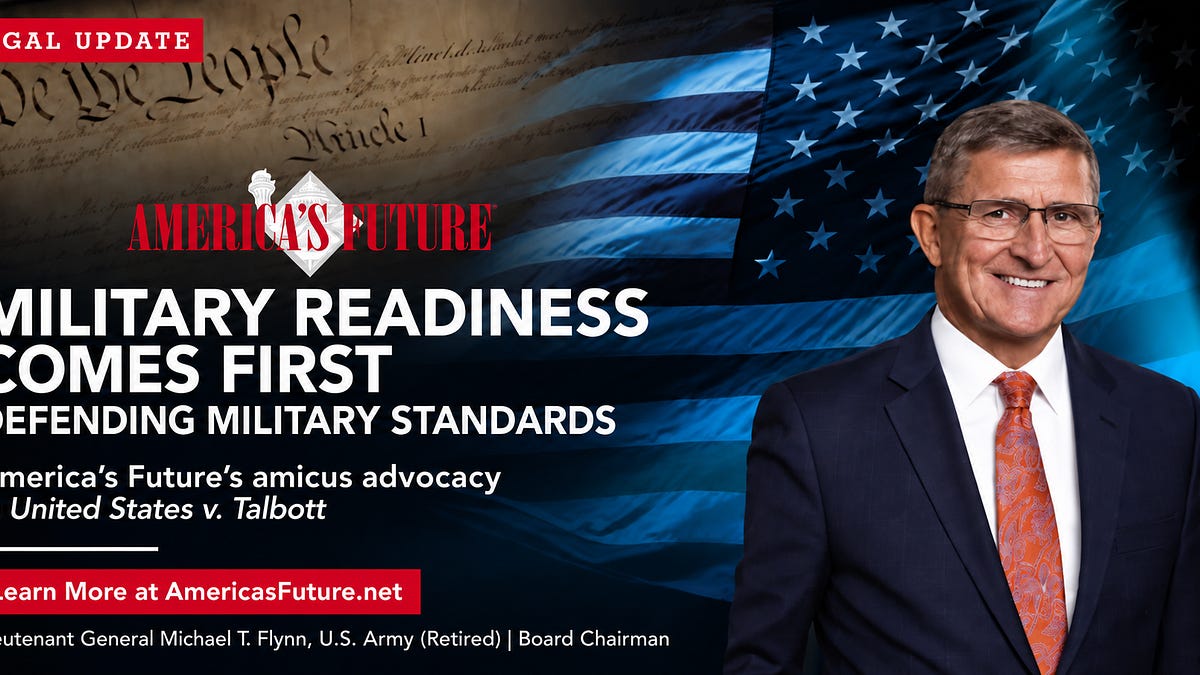
America’s Future, where I serve as Board Chairman, has joined an amicus brief in United States v. Squire asking the court to confront that question. We are defending gun rights and the limits our Founders placed on federal power.
This legal work is possible because people support America’s Future. I’m grateful to every one of you who has stood with us. If you want to help us continue these legal battles for our rights, you can donate on our organization’s website.
I explain what is at stake in my new article.
https://www.generalflynn.com/united-states-v-squire-gun-rights-commerce-clause
What does it mean and what does it take to be an American?
Check out what America’s Future is doing to protect our God-given rights.
https://www.americasfuture.net/newsletter/defend-the-constitution-protect-our-future/
Let me tell you something straight up—President Trump’s tariffs are a bold, decisive strike for America’s soul. This isn’t just about trade; it’s about taking back what’s ours—our jobs, industries, and our pride. For too long, we’ve let the globalists and the weak-kneed elites sell us out to foreign powers who don’t give a damn about the American worker.